A Closer Look at Planning factory acceptance checks for equipment
Factory acceptance checks are useful when the machine configuration, test conditions, acceptance criteria, evidence, and decision authority are agreed before the supplier demonstration. Buyers should distinguish factory checks from site acceptance, record actual results, and keep unresolved items tied to a clear shipment decision.
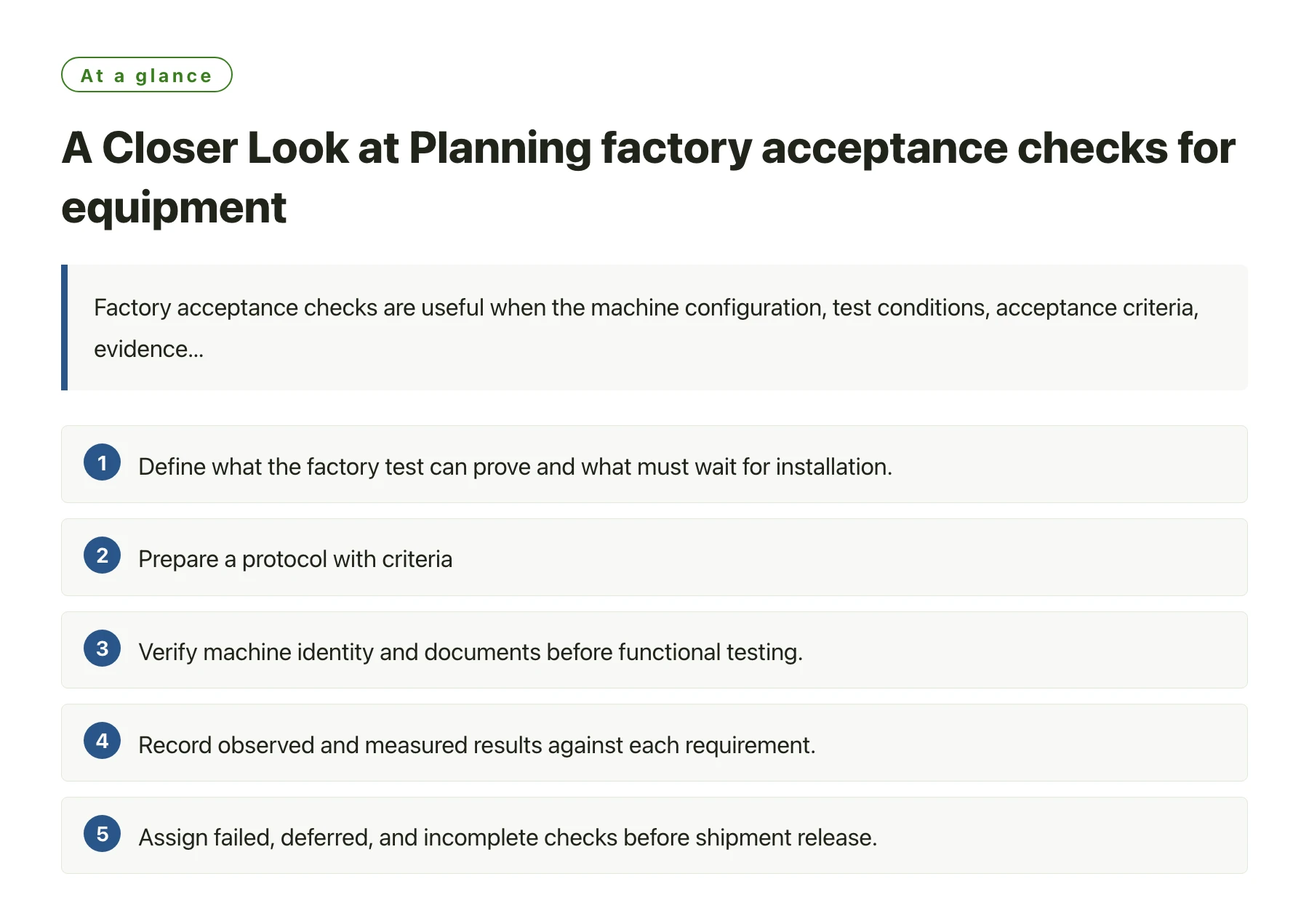
Key takeaways
- Define what the factory test can prove and what must wait for installation.
- Prepare a protocol with criteria, instruments, conditions, owners, and evidence.
- Verify machine identity and documents before functional testing.
- Record observed and measured results against each requirement.
- Assign failed, deferred, and incomplete checks before shipment release.
An acceptance test should answer specific purchase questions. A demonstration without agreed conditions or recorded criteria can leave important gaps hidden until installation.
Decide what the factory test must prove
A factory acceptance check should confirm that the equipment configuration and selected functions meet agreed purchase requirements before dispatch. Start by listing the decisions the buyer needs to make: verify model and options, demonstrate operating sequences, record measured performance, review safety functions, confirm documentation, or identify remaining work. Avoid treating a general demonstration as acceptance of the complete machine.
Separate factory acceptance from site acceptance. A factory check occurs at the supplier’s facility under available conditions; site acceptance may depend on installation, utilities, integration, and the buyer’s actual production environment. Identify which requirements can be proven at the factory and which must wait until installation or commissioning.
For machinery safety, ISO 12100 describes principles and a methodology for risk assessment and risk reduction during relevant lifecycle phases. The machine designer and qualified safety reviewer should identify applicable hazards and requirements; a buyer’s acceptance checklist should verify agreed evidence without replacing that engineering assessment.[1]
Prepare a test protocol tied to the contract
Use the approved purchase specification, drawings, options list, operating conditions, and acceptance criteria as the test basis. Identify the machine serial or build number, software revision, test date, location, buyer and supplier witnesses, and equipment configuration. If the contract names standards or tests, specify their edition and the responsible party.
For each check, state the procedure, instrument, measurement unit, acceptance range, evidence required, and result field. Define whether a pass requires every criterion, whether any checks are informational, and how deviations are recorded. Assign specialist measurements or safety validation to competent reviewers with suitable instruments.
Share the protocol before the test date. Confirm access, power, utilities, raw material, tooling, operator, guards, test loads, and safe operating conditions. Decide who supplies consumables and who may stop the test. If the required test cannot be run at the factory, identify an alternative evidence method or a site hold point before dispatch.
Verify identity, configuration, and documentation
Begin by matching machine nameplate, serial number, model, options, major components, drawings, and approved changes with the purchase record. Check that guards, enclosures, controls, and accessories match the agreed configuration. Record any alternate component or software version before testing continues.
Review the document pack: manuals, wiring diagrams, parts lists, maintenance instructions, certificates or reports specified by contract, calibration records, and training materials. Confirm document language, revision, model reference, and whether files are final. A generic manual or report for another machine should be logged as an open item.
Check safety labels and emergency functions only against the approved design and applicable requirements. Do not bypass guards or operate unfamiliar equipment outside the supplier’s safe test instructions. Confirm the operator and witnesses understand stop controls and site safety rules.
Run functional checks and record results
Test the agreed modes and sequences under stated conditions. Observe startup, normal operation, control response, alarms, interlocks, changeover, and shutdown where these are part of the requirement. Record actual measured values rather than writing only acceptable. If a measurement depends on a specific material, speed, load, or environment, include that context in the result.
Where output capability matters, define a representative test run and how performance is measured. Record sample quantity, cycle time, quality criteria, stoppages, and excluded conditions. A brief run may verify a function but not establish long-term reliability, sustained capacity, or performance across every production scenario.
Capture observations and evidence contemporaneously. Identify test step, time, machine state, instrument, result, photograph or video reference, and witness. Keep raw results with the final summary so a later reviewer can understand how the pass decision was reached.
Manage failures, punch lists, and shipment release
Classify a failed or incomplete check by contract requirement and project consequence. Record the condition, evidence, immediate containment, responsible owner, corrective action, retest method, and target date. Do not convert an unresolved requirement into a pass through an informal discussion.
Separate dispatch-critical items from site-dependent tasks using buyer-approved rules. Name who can accept a deviation, defer a check to site, or hold shipment. If a correction changes machine design, component, software, or safeguards, ask qualified owners to determine what additional review or test is required.
Issue a signed summary with checks passed, failed, not tested, deferred, documents outstanding, and punch-list owners. Attach the final configuration, reports, and approved deviations. Tie release to the responsible buyer’s written decision and update the shipment plan if corrective work changes readiness.
For industrial equipment sourcing support, buyers can arrange coordination of the test schedule, supplier documents, witnesses, and punch-list follow-up. Define whether the service provider observes or conducts technical tests, what competence is required, and who retains final acceptance authority.
Sources
Frequently asked questions
Does a factory acceptance test replace site acceptance?
No. Some requirements depend on installation, site utilities, interfaces, or the actual operating environment and need separate verification after delivery.
What if a required test cannot be performed at the factory?
Record the limitation, agree on alternative evidence or a site hold point, and assign an owner and release condition before dispatch.
Who can approve a test deviation?
Name the buyer’s authorized technical or quality owner in advance. Record the deviation, impact, evidence, and written disposition in the acceptance file.
What should an acceptance summary contain?
List the tested configuration, conditions, criteria, actual results, evidence, passed and failed items, deferred checks, open documents, owners, and release decision.