New Releases vs Established Characters
Every browsing session contains the same quiet trade: open the listing published last week, or return to the one with a year of evidence behind it. The established option carries proof — Eri's card shows 24.3M views and 7.1K favourites, a ratio near 0.029% — while the new release carries the one thing proof cannot offer, which is surprise. The right answer depends on what you want from the next twenty minutes, and the two cases fail in entirely different ways.

Key takeaways
- Established listings have measurable evidence: views, favourites and an attribution history that a new release cannot have yet.
- New releases win on premise rather than polish, and the win is front-loaded into the first week.
- A new listing with matching tags but a vague description loses to an older one on both counts.
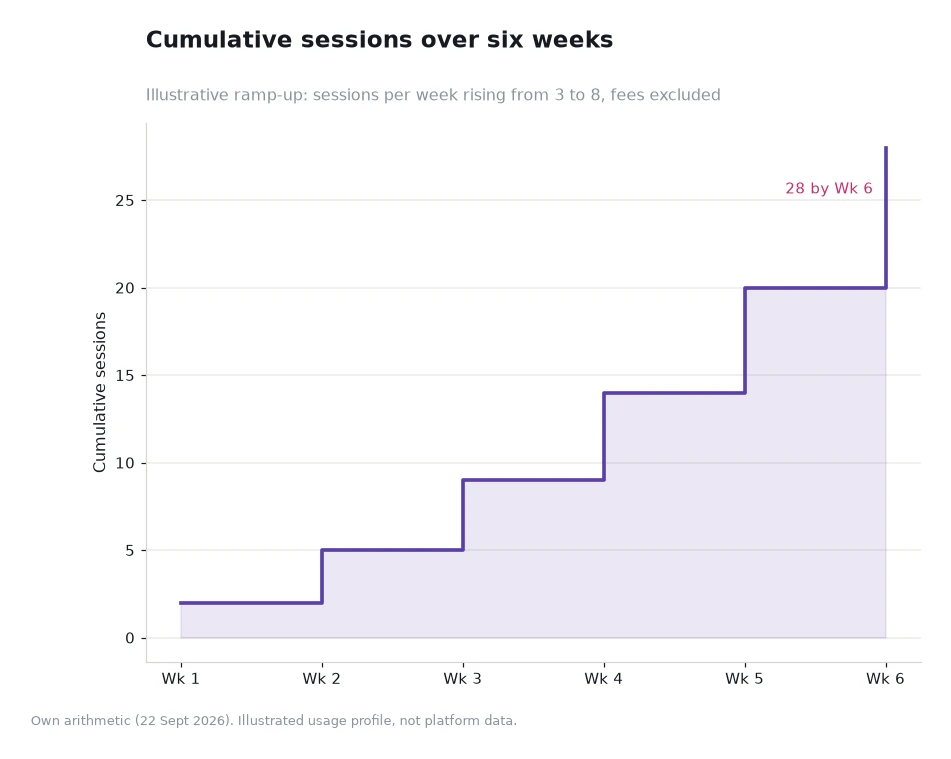
- On the illustrative profile below, six weeks of light use accumulate 28 sessions from weekly additions of 2, 3, 4, 5, 6 and 8.
What the new release actually offers
New listings are written by someone who has just decided what they want the character to be, and that clarity often shows in the premise. The description is usually more specific and the personality more sharply drawn than in a listing that has been rewritten six times. For a reader who is bored with familiar registers, that specificity is the whole appeal.
The cost is uncertainty. There is no favourite count worth reading, no record of how the listing performs after a weekly reset, and no way to tell whether the description reflects twenty minutes of work or two hours. The novelty premium is real, but it is being paid for with evidence you do not yet have.
The weekly reset is the natural clock for this. Because rankings refresh every Thursday, a new listing has at most seven days of uncontested novelty before it competes on the same terms as everything else. One easy test is to note a release in week one and look for it again after the reset: if it is still visible, the premise is carrying it rather than the launch.
What the established listing offers
An established listing offers three things a new one cannot: a ratio, a history and an author. The ratio says whether people who opened it stayed. The history says whether it survives the Thursday reset more than once. The author says whether the same voice has written other listings you might like equally.
Its weakness is familiarity. A listing that has been in the top set for months has been read by everyone with the same taste, and its premise has probably been explored by you already. Polish does not create surprise, and surprise is what a repeat visitor is often looking for.
There is a cheaper test of an established listing than committing a whole session to it. Open the thread, write four or five messages, and read the replies for register rather than content. A listing with a strong favourite ratio usually shows its register inside five exchanges, which is enough to decide whether the next twenty minutes belong to it.
| Dimension | New release | Established listing |
|---|---|---|
| Premise clarity | Usually sharper, written with intent | Often broader after repeated edits |
| Evidence | No meaningful favourite ratio yet | Ratios in the 0.015% to 0.029% band are readable |
| Author track record | Unknown until the author publishes more | Attribution line with a visible history |
| Discoverability | Depends entirely on tags being right | Reaches shortlists through accumulated ranking position |
| Familiarity | High novelty, low polish | Low novelty, high polish |
Worked example
Suppose you divide six weeks of light use between the two options. The illustration charted below is arithmetic written for this article, not platform data. Weekly additions run 2, 3, 4, 5, 6 and 8 sessions, giving cumulative totals of 2, 5, 9, 14, 20 and 28.
Walk the line: after week one, 2 sessions. Week two adds 3 for 5. Week three adds 4 for 9. Week four adds 5 for 14. Week five adds 6 for 20. Week six adds 8 for 28. Half the total, 14 of 28 sessions, arrives in the final two weeks.
Now split the budget. Give the first two weeks to new releases: 2 + 3 = 5 sessions, covering perhaps five different listings. Give the last four weeks to one established listing: 4 + 5 + 6 + 8 = 23 sessions on a single thread. The new-release half costs you five unknowns to reach five sessions; the established half builds 23 sessions of continuity. Neither is wrong, but only one of them produces a thread that remembers anything.
Split it by time rather than by session and the same shape appears. At an assumed 20 minutes a session, the five new-release trials consume about 100 minutes, while the 23 established sessions take roughly 460 minutes. The first half buys information; the second half buys continuity. Both are reasonable purchases, as long as you know which one you are making.
Choosing without regretting it
A workable rule is to give every new release one short session and every established listing the sessions after that. One session is enough to test a premise; it is not enough to test a memory, so nothing is lost by moving on. Conversely, a listing with a good ratio has already passed a test you would otherwise have to run yourself.
Two habits make the comparison fairer. First, check the tags before you check the description, because a new release with the wrong tags never reaches the shortlist where the description would have been read. Second, look at the attribution line: a second listing from an author whose first one worked is a better bet than a first listing from an unknown name. The weekly rankings and the AI chat blog are where those patterns become visible over time.
It is worth being honest about what neither option fixes. A premise that does not interest you stays uninteresting whether it is proven or fresh, and no ratio makes a register you dislike bearable. The comparison above reduces uncertainty; it does not guarantee a good evening, and treating it as a guarantee is how people end up with a long list of listings they never return to.
If you are specifically chasing the newest material, start from the porn ai chat entry point, where the Crushon Porn Chat AI page sets out what customisable characters and adaptive responses mean in practice — the two traits that decide whether a promising premise survives its second week.
Frequently asked questions
Are new releases worse quality?
Not necessarily. They are unproven. A new listing may have a sharper premise and no evidence, which is a different problem from being poorly written.
How many sessions before a listing feels settled?
Three or four. That is roughly when a consistent register has enough history to hold, and when an inconsistent one has enough history to show it.
What is the strongest signal on an established card?
The ratio between favourites and views. Takara's 4.7K favourites against 18.2M views is about 0.026%, which is evidence a new listing cannot present yet.
Let the ratio decide, then let the premise surprise you
Use established listings when you want a session that works, and new releases when you want a session that might. One short trial per new release keeps the cost of being wrong at a single sitting.
Then revisit the trial a week later. A premise that still reads well after seven days is worth the longer investment, and that is the only version of this choice with a reliable answer. Content is intended for adults aged 18 and over.
Data and sources: trend card counters, ranking wording and platform descriptions read on 22 Sept 2026[1]. Favourite ratios are arithmetic on those counters; the six-week session profile and the 5-versus-23 session split are illustrative assumptions, not platform figures. Adults only, 18+.